EspaciosSpaces
Cómo crear un espacio de escucha más equilibradoHow to create a more balanced listening space
Colocación, simetría y materiales cotidianos antes de comprar tratamiento acústico.Placement, symmetry and everyday materials before buying acoustic treatment.

Un espacio de escucha equilibrado no empieza comprando paneles. Empieza colocando con intención lo que ya existe, escuchando un cambio a la vez y dejando que la habitación cumpla también su función cotidiana.
Construye una posición inicial
Coloca las dos bocinas a la misma distancia aproximada del punto principal de escucha y empieza con una separación entre ellas similar a la distancia hacia ti. No es una fórmula rígida: es un triángulo inicial fácil de evaluar. Si las voces parecen concentrarse en el centro y la escena no se rompe, ya tienes una referencia útil.
Procura simetría lateral: distancias parecidas a los muros y obstáculos para la bocina izquierda y derecha. Una habitación nunca es perfectamente simétrica, pero una estantería abierta junto a una bocina y un muro desnudo junto a la otra producirán reflexiones diferentes.
Muros, orientación y altura
La distancia al muro trasero cambia la respuesta en graves y las cancelaciones. No existe una separación universal; algunos diseños trabajan cerca del muro y otros necesitan más aire. Empieza con el manual de la bocina, conserva ventilación en puertos traseros y mueve ambas unidades en incrementos pequeños.
Orienta las bocinas hacia el punto de escucha como punto de partida. Después reduce o aumenta ligeramente el ángulo para ajustar la imagen y los agudos. Mantén los tweeters cerca de la altura del oído o dirige el eje acústico según la recomendación del fabricante. Evita que una bocina quede más alta que la otra.
Alfombras, cortinas y superficies
Piso, cristales y muros desnudos reflejan energía. Una alfombra entre las bocinas y el asiento, cortinas con cierta masa, libreros y mobiliario tapizado pueden reducir parte de las reflexiones de medias y altas frecuencias. No “insonorizan” la habitación ni controlan por sí solos los graves, pero pueden disminuir un carácter excesivamente vivo.
Añade materiales gradualmente. Si todo se cubre con absorción ligera, la sala puede perder vida en agudos mientras los problemas de baja frecuencia permanecen. Escucha palmas, voz hablada y música conocida después de cada cambio.
Mobiliario, ruido visual y uso real
El mueble debe ser estable, permitir operar la tornamesa sin golpes y mantener ventilación alrededor de amplificadores, receivers y fuentes de calor. Respeta los espacios libres del manual; no cierres equipos en un compartimento sólo por ocultarlos.
Organiza cables de señal y energía sin tensarlos. Sepáralos cuando aparezca ruido, evita bobinas apretadas de cable sobrante y conserva acceso para mantenimiento. Una ruta clara reduce desconexiones accidentales y también el ruido visual.
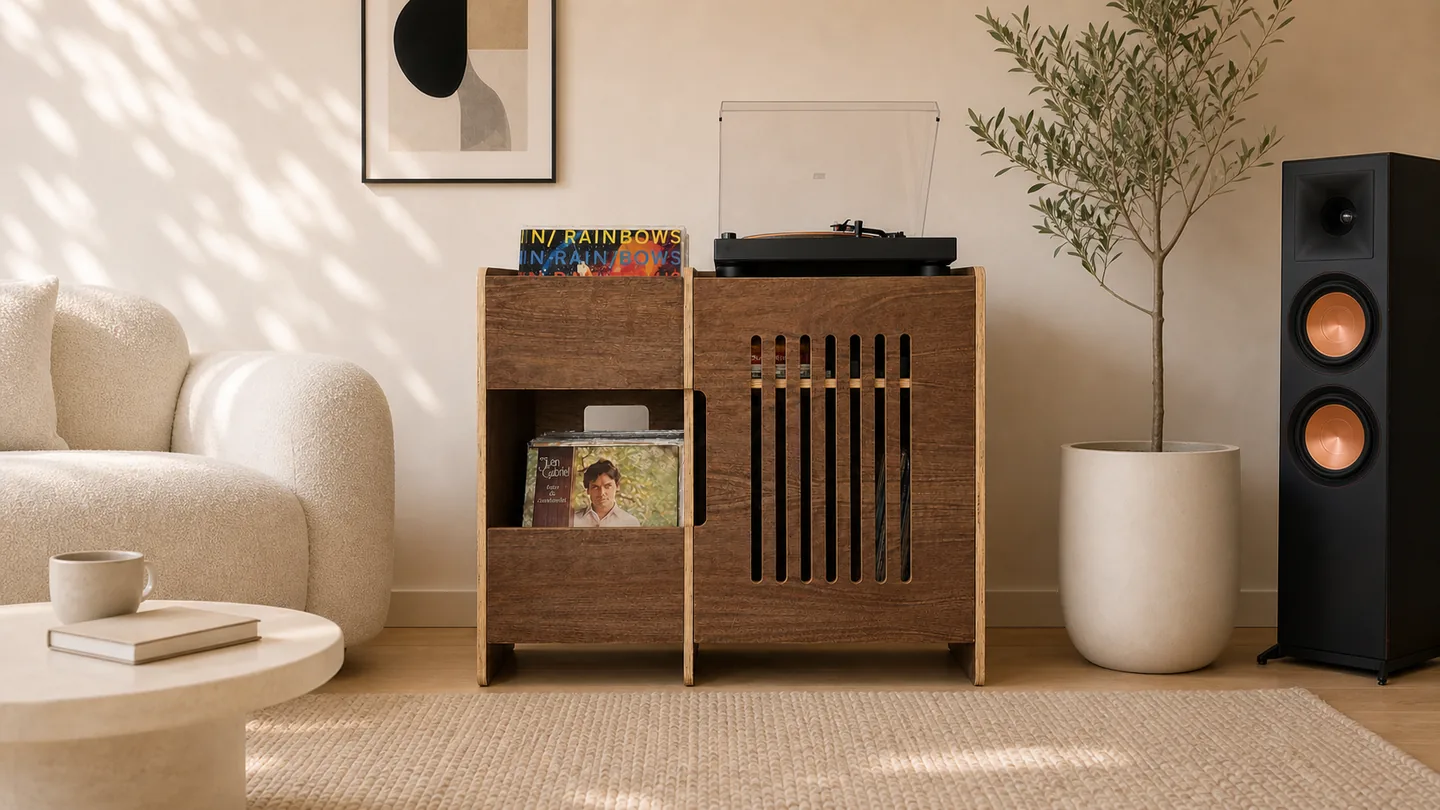
La colección debe quedar accesible sin invadir el paso. Un espacio que obliga a mover una bocina cada vez que eliges un disco difícilmente conservará su configuración. El mobiliario de la colección Tempo busca integrar estos gestos, pero el principio puede aplicarse con cualquier solución estable y proporcionada.
Prueba antes de tratar
- Marca la posición actual con cinta removible.
- Cambia una variable: separación, distancia al muro o ángulo.
- Escucha las mismas piezas al mismo volumen.
- Conserva el cambio sólo si mejora más de una grabación.
- Mide o consulta a un profesional antes de comprar tratamiento específico.
Los paneles y trampas de graves pueden ser eficaces cuando responden a un problema identificado. Sin diagnóstico, es fácil gastar en piezas insuficientes, colocarlas donde no ayudan o corregir un síntoma que se resolvía moviendo el asiento.
A balanced listening space does not begin with buying panels. It begins by placing what you already own with intention, listening to one change at a time and letting the room continue to serve everyday life.
Build a starting position
Place both speakers at roughly the same distance from the main listening point and begin with a spacing between them similar to the distance from each speaker to you. This is not a rigid formula; it is an easy starting triangle. If voices focus at the centre and the image remains coherent, you have a useful reference.
Aim for lateral symmetry: similar distances to walls and obstacles for left and right. No room is perfect, but an open bookcase beside one speaker and a bare wall beside the other create different reflections.
Walls, toe-in and height
Distance to the front wall changes bass response and cancellation. There is no universal gap; some speakers work close to a wall while others need more space. Begin with the speaker manual, preserve airflow around rear ports and move both units in small increments.
Aim the speakers toward the listening position as a starting point. Then reduce or increase toe-in slightly to adjust imaging and treble. Keep tweeters near ear height, or aim the acoustic axis as the maker recommends. Avoid placing one speaker higher than the other.
Rugs, curtains and surfaces
Floors, glazing and bare walls reflect energy. A rug between speakers and seat, curtains with some mass, bookshelves and upholstered furniture can reduce part of the mid- and high-frequency reflections. They do not soundproof the room or control bass by themselves, but they can calm an overly live character.
Add materials gradually. Covering everything with light absorption can dull treble while leaving low-frequency problems untouched. Listen to handclaps, speech and familiar music after each change.
Furniture, visual noise and real use
Furniture should be stable, allow turntable operation without impact and preserve ventilation around amplifiers, receivers and other heat sources. Follow the clearances in each manual; do not enclose equipment simply to hide it.
Route signal and power cables without tension. Separate them when noise appears, avoid tight coils of excess cable and preserve maintenance access. A clear route reduces accidental disconnection and visual noise.
The collection should be accessible without blocking movement. A room that requires moving a speaker every time you choose a record will not keep its setup. Furniture in the Tempo collection is designed around these gestures, but the principle applies to any stable, well-proportioned solution.
Test before treating
- Mark the current position with removable tape.
- Change one variable: spacing, wall distance or toe-in.
- Use the same music at the same volume.
- Keep a change only when it improves more than one recording.
- Measure or consult a professional before buying specific treatment.
Panels and bass traps can be effective when they address an identified problem. Without diagnosis, it is easy to buy pieces that are too thin, put them where they do little or treat a symptom that moving the seat would solve.